

On this page
One targeted molecular signal about the prostate
Two separate genes in prostate cells: TMPRSS2 and ERG.
In some prostate tumours, the two join together – this is a gene fusion.
The imprint of this junction may enter the urine, and the laboratory specifically looks for it.
Not every tumour carries this alteration, and even when it is present, it does not always reach the urine in a detectable amount.
PC-Alarm Focus looks for the signal of the TMPRSS2–ERG gene fusion in the urine sample. This is a genetic alteration that appears in some prostate tumours; the test looks specifically for its trace.
A PSA test measures the blood level of a protein, which can also be raised because of benign prostate enlargement or inflammation. PC-Alarm Focus examines a different measurement target, so its result is best interpreted alongside PSA and urological findings.
You will find the details of the measurement and the results of the exploratory comparisons on the Scientific background page.
What information do you get?
- Whether the imprint of the gene fusion typical of prostate cancer (TMPRSS2-ERG) is detectable in the sample.
- The result arrives as a report with an explanation that helps you read it.
- The report records the result of the measurement carried out on that particular urine sample.
How to use the report
- The diagnosis is established by specialist investigation, usually by tissue examination.
- The extent and aggressiveness of a tumour are assessed by other examinations.
- A negative result does not rule out prostate cancer.
- Continue PSA-based follow-up and urological investigation as advised by your doctor.
In what situation is it worth finding out about it?
If an investigation is already under way because of a raised PSA or an inconclusive urological finding, you can discuss the role of PC-Alarm Focus with your doctor. If you are finding out about the test now, the points below help you understand what information it gives.
In the case of a raised PSA value
The test can give molecular information that differs from PSA for the investigation under way. You can collect the sample at home; your doctor assesses the report together with your other results.
In the case of an inconclusive urological finding or an abnormality on digital examination
Examining the targeted gene fusion gives a different kind of data from a digital examination. The result can be added to your existing findings; your doctor decides on further investigation.
If you are finding out about molecular information that differs from PSA
PC-Alarm Focus looks for the trace of one specific gene fusion. The sample can be collected at home, and you receive the report with an explanation. A negative result does not rule out prostate cancer; the test complements PSA and urological examination.
What does the result mean alongside your PSA level?
The result says little on its own. The table estimates how many men out of 100 similar men have cancer – according to the PSA level and what the urine test showed.

The figures are estimates from large patient groups. They are not your individual risk, and not a diagnosis.
| PSA level (ng/ml) | Without a PC-Alarm Focus test | Negative PC-Alarm Focus test | Positive PC-Alarm Focus test |
|---|---|---|---|
| 0 – 0.5 | 7 | 6 | 9 |
| 0.6 – 1.0 | 10 | 10 | 14 |
| 1.1 – 2.0 | 17 | 16 | 23 |
| 2.1 – 3.0 | 24 | 23 | 31 |
| 3.1 – 4.0 | 27 | 26 | 34 |
| 4 – 10 | 30 | 27 | 55 |
| 10 – 20 | 65 | 61 | 84 |
Every figure means: this many out of 100 similar men have cancer.
Without a PC-Alarm Focus test
30 with cancer out of 100 men
Negative PC-Alarm Focus test
27 with cancer out of 100 men
Positive PC-Alarm Focus test
55 with cancer out of 100 men
Each dot is one man; the highlighted dots are those with cancer. The same three figures as the 4 to 10 row of the table.
How to read it
Find your PSA level in the left-hand column and read across the row. The second column shows where you would stand without the urine test; the other two show how much the result changes that.
The negative column barely differs from the second one. A negative result is therefore not an all-clear: your situation stays essentially what it was before the test. With a PSA between 4 and 10, out of 100 similar men 27 rather than 30 have cancer – a difference of 3 men in 100. The reason is that only some prostate cancers develop this genetic change, so the test cannot flag a substantial share of cancers.
The test matters most where PSA is between 4 and 10. In that band a positive result raises the figure from 30 to 55 out of 100 men – the largest change in the table.
Above a PSA of 10, the high level warrants investigation in itself, whatever the urine test shows.
Below a PSA of 4, even a positive result means only 9–34 men with cancer out of 100: most positive results here have no cancer behind them.
With a negative result and a PSA above 4, investigation continues on the basis of the PSA – a negative result does not postpone it.
The two columns for the test are estimates from our own data on a small number of patients. In the 4 to 10 row, the true value of the positive column may lie anywhere between 14 and 91 out of 100 on current data; 55 is the best present estimate.
How the figures are calculated, and their sources
The right timing for sample collection
- Wait two weeks after chemotherapy or radiotherapy, and at least six weeks after prostate surgery.
- After prostate removal and while a catheter is in place, the sampling conditions of the service are not met. In such a case, discuss the appropriate examination with your doctor.
- The test was developed for urine samples from adult men only.
A negative result is not a reason to suspend an investigation already started or to postpone planned examinations. Your doctor decides on the next steps.
Four simple steps to collecting the sample at home
You collect the package, take a sample at home, then return it to the laboratory. The guide in the package takes you through what to do.
You collect the kit
The sampling kit arrives at the parcel locker you chose when ordering. You pay on collection, in the way stated at ordering. The kit holds the tube, the illustrated guide and the return packaging.

You take the sample at home
Collect a sample from the first part of the first morning urine into the tube supplied, up to the amount marked in the guide. The tube contains a stabilising agent; after closing it, invert it gently as described in the guide. Follow the guide enclosed with the package for hygiene preparation and timing as well.
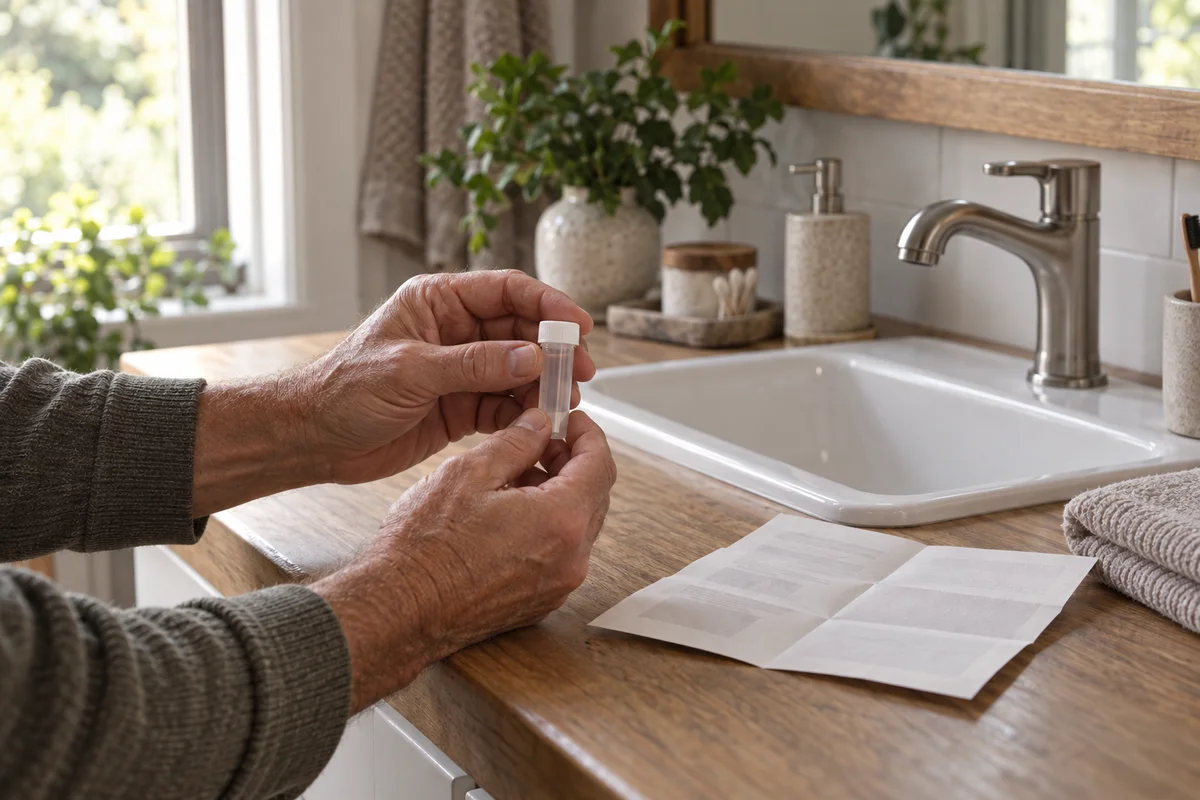
You keep it at room temperature
Store the sealed sample at room temperature, protected from direct sunlight. No refrigeration is needed. Post it so that it reaches the laboratory within 7 days of collection.
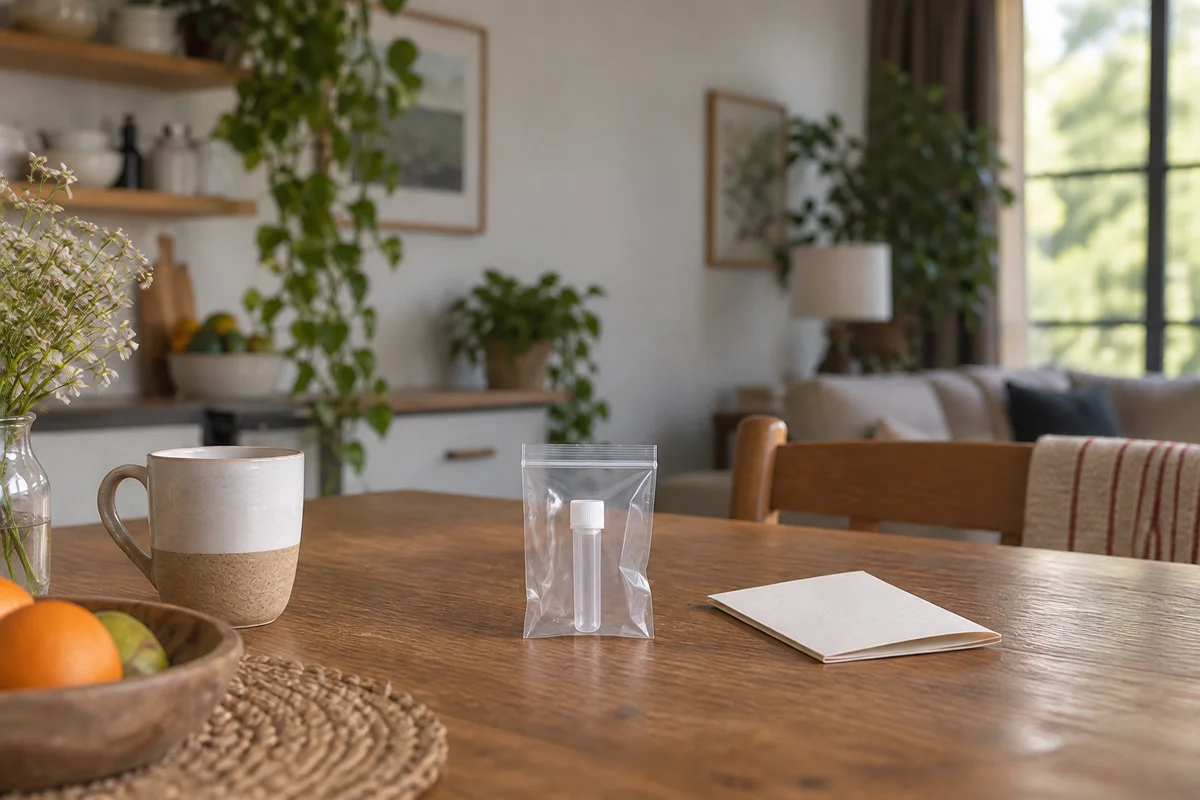
You post it to the lab
The sample travels back in the same packaging, using the posting method given in the kit and in your account. Return shipping is included in the price.



The three possible results of the report
You can download the report from your secure account, together with an explanation in Hungarian. The result is expected within 10 working days of the sample arriving at the laboratory.
Negative
The imprint of the gene fusion was not detectable.
This does not rule out prostate cancer: not every tumour carries the alteration, and even when it is present the signal cannot always be detected in urine. The result should therefore be assessed together with the PSA value, the findings of the urological examination, any imaging results and individual risk factors.
A negative result is no reason to suspend an investigation already under way or to postpone planned examinations. Your treating physician decides on the next steps.
Positive
The imprint of the gene fusion typical of prostate cancer was detectable in the sample.
The test identifies an abnormal genetic signal appearing in the cells of the prostate. It does not determine the extent or the aggressiveness of a tumour.
Take the report to your urologist: the result warrants further investigation. A positive report is not in itself a diagnosis; establishing one is a specialist task, usually by tissue examination.
Not evaluable
The sample did not yield an evaluable result.
The laboratory uses control measurements to check whether the RNA can be analysed and whether material of prostate origin is present. If no evaluable result can be issued from the sample, a repeat sample is needed.
If no evaluable result can be issued from the sample, a new sample is needed. We provide one free repeat, under the conditions set out in the Terms and Conditions. We will let you know how to request the new kit and what to do when collecting the sample.
How to use your report
- It is best to interpret the PC-Alarm Focus result together with PSA and urological findings.
- Always discuss the result with your doctor.
- The report is the result of a targeted molecular measurement. On its own it does not establish a diagnosis, and a negative result does not rule out prostate cancer.
- You receive a written explanation with the report; a separate medical consultation is not included in the price.
- You can download the report from your secure account, and it is you who shares it with your doctor. You can read about how data are handled in the Privacy notice.
Terms
A few expressions that appear on the report and on this page.
- PSA
- Prostate-specific antigen: a protein level measured in blood. Characteristic of the prostate, but not exclusively of cancer: it can also rise because of benign enlargement or inflammation.
- Digital rectal examination (DRE)
- Examination of the prostate through the rectum. PC-Alarm Focus sampling does not require it.
- TMPRSS2-ERG
- The name for the joining of the TMPRSS2 and ERG genes. The test looks for the RNA signal of one specific variant of this gene fusion. It is an acquired alteration at cell level, not a test for inherited predisposition. According to published studies it is not characteristic of benign prostate tissue.
- RNA
- Ribonucleic acid: a molecule involved in how cells work. The laboratory looks for the RNA signal belonging to the gene fusion; the stabilising agent in the sampling tube helps preserve it for the measurement.
- Indication
- The professionally defined situation in which using the test may be warranted.
- EESZT
- Electronic Health Service Space (EESZT). Detailed information about access to the PC-Alarm Focus report and about data handling is given in the service notice.
Downloads
The same documents are in the kit as well.
Sampling guide
Illustrated, step-by-step guide to taking the urine sample at home and sending the kit back.
DownloadPDF · 1.1 MBProfessional summary
Detailed clinical and technical description of the TMPRSS2-ERG marker, for healthcare professionals.
DownloadPDF · 1.5 MBPatient information
A short overview of the service that you can also share with a family member.
DownloadPDF · 1.0 MBSpecimen report
Anonymised example of what the report looks like: structure, fields and how the result is interpreted.
DownloadPDF · 1.1 MB
Frequently asked questions
Answers to questions about sample collection, the report and the service. You will find further information about ordering on the home page.
The 79 900 Ft covers the home sample collection kit and guide, delivery both ways, the targeted molecular laboratory analysis, and the downloadable report with an explanation to help you interpret it. The fee for a separate medical consultation is not included in the price of the package.
Start the test with home sample collection
79 900 Ft - sampling kit, laboratory test, result and shipping both ways. No prior registration.